A couple of years ago when Chat GPT went mainstream, every English teacher and professor noticed the same thing: All of a sudden every student on Earth could write perfectly.
It was laughable. Kids who routinely spell their last names wrong all of a sudden were pontificating poetic in the Google Classroom on identity and literature. They were the same kids who had proudly told the class they lost their book and hadn’t even started reading it yet. Kids were coming up with synonyms for shit, starting sentences with dependent clauses, and gleaning meanings into the literature we had not talked about in class, or even thought of ourselves. It was wild.
And the job changed.
Instead of being writing instructors helping students see deeper into the world of ideas, we were now internet sleuths, using multiple AI checkers to find copy cats. Instead of examining their writing for original ideas and giving them feedback, we were angrily pasting text onto AI sites that told us the paragraphs were 95% plagiarized. Every kid we caught was guilty af.
But then the relationships changed too.
Because most of the students refused to admit to it. Yes, we would have 2-3 AI checkers’ sordid results, we would have examples of their other sucky assignments that were handwritten, we would even have the site they got it off of word for word, and even then these kids would SWEAR they didn’t cheat. We couldn’t tell if they thought using AI was so normal that it wasn’t cheating, or they just thought there is no way to prove the AI checkers were right, so they were sticking to their silly innocences.
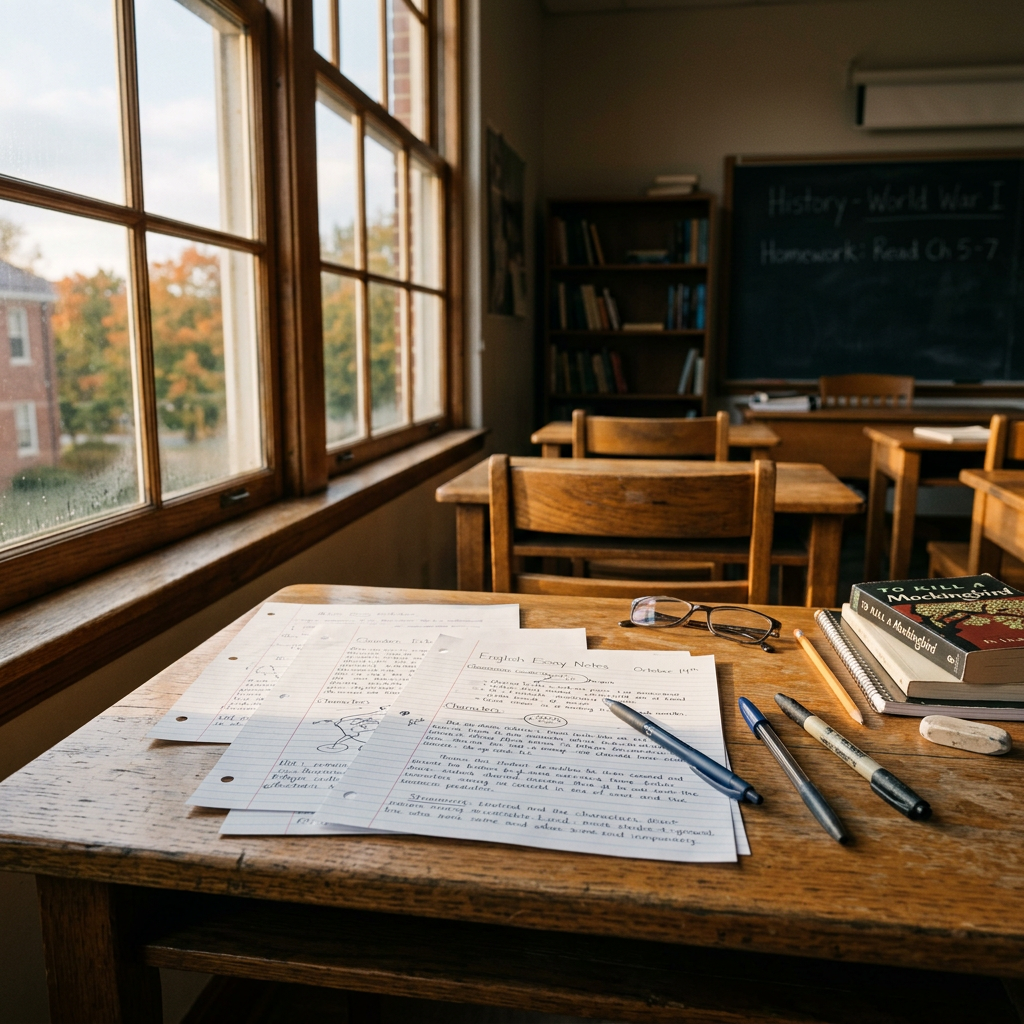
I made the adjustment very quickly. I hate phones, computers, screens, tiktok, and scrolling anyway. I just went back to doing what I had always been doing before COVID moved everyone onto screens. I went back to paper and pencil. That was two years ago. Right when AI began, the use of computers in my classroom ended.
And it has been fabulous.
Look, we all know these tech leaders and tech companies have sold us snake oil. They promised these screens would make our lives better. But we are over a decade and a half from the first iPhone and people are not happier–they are the opposite. Kids have lost chunks of their childhoods to screens and will never get them back. Covid took a toll on all of us, and the worst part was not the virus itself, but it was the final nail in our new online coffins. It turns out going onto screens full time is not the answer, it is the problem.
I remember when NONE of my students had computers. Then came the rush to get 1-1, the golden ration of students to laptops. My school did not have that until COVID. Now it seems most schools are giving most kids their own laptops. My own two kids each get a Chromebook at their schools, and they have Google Classrooms 6 periods a day.
It’s maddening. And it’s lazy teaching.
Google Classrooms are not teaching. Teaching is not about typing a prompt and having kids respond with a paragraph while you sit at your desk. In the age of AI those paragraphs are mostly being plagiarized. In math class all you need to do is take a pic of your math problem and Chat GPT will solve it with the work showing. Unless you are a master AI detector and you are using multiple sites and plugins and apps, your students are cheating. Even if you have all that, your students are still cheating. Don’t believe me? Ask a couple high school students about what is going on in their Google Classrooms. They will laugh at you for thinking they’re not all cheating. “Oh, I mean every single kid I know is doing it,” one student told me. “In every single class.” If you have a Google Classroom and haven’t caught dozens upon dozens of students by now, you are getting played.
So stop it.
All writing in my class is done with pencil and paper. I tailor my assignments so even the thinking and brainstorming is all done in class. They have nowhere to turn for help, except for maybe each other. They have until the end of the period to turn it in and then it goes straight into the gradebook. I pride myself on putting assignments in the gradebook at the end of every day (except for long essays), and so after a few weeks they understand they have to come to class and listen, think, and do assignments by hand with nothing but their mind and maybe a partner or group to help them. That is it.
Look, I am old, I know that, but this isn’t about going backwards to oldentimes. To be honest, the students lightweight find it new and refreshing. They’ve told me to get other teachers to do it. They are tired of sitting down 6 hours a day and checking into a Google classroom, hunched over a screen to submit more bullshit. They want to have discussions, they want to be challenged. They want dynamic, interesting, real teaching.
Now, I still assign typed papers in MLA format with a Works Cited page. And I do allow computers in my classroom for research and typing. I am not a complete luddite (although I would like to see a luddite movement among youth to get away from screens). But even when they type up their papers, they are not allowed to make changes. They write a first draft, paragraph by paragraph, in class. Think of it like an Intro on Monday, body paragraph 1 on Tuesday, body paragraphs 2 and 3 and conclusion to round out the week. It doesn’t really go like that but you get the drift. Every one of those paragraphs begins with a lesson, whether I model an intro myself, we brainstorm thesis statements on the white board as a class, or I give them a paragraph structure for body paragraphs and how to incorporate quotes. We write with pencils and pens on paper piece by piece and they turn it in at the end of the period. Then they type it up. I have a handout that allows them to change 5 sentences and five sentences ONLY. They have to write down the original and the revised sentence on the handout. I try to make sure they are important sentences, like analysis or theses. Then they turn that handout in with their first handwritten and final typed draft so I can see it is exactly what they wrote by hand except for those five sentences.
Back in the day we would do peer editing to try and make student papers as perfect as possible, but now I am looking for imperfection. I am looking for the writing to be human. I am now a purveyor of errors, and when I see bad syntax and insufficient commentary I know it was written by a kid. And I can see what they need help with as a class. I can still give out As with the errors, as long as they are giving me their best shot and growing as a writer.
I have many more approaches than just this, but I hope you can see that I am not just attempting to create in my classroom some technophobic Amish paradise. I am trying to get them to think again, and write for themselves. I stand on that.
I like this article by Debbie Millman of the New York Times, If You’re Over 40 You’re Ready to Use AI. She claims you shouldn’t be using AI until you’re 40 because only then have you been thinking for yourself for decades. Students don’t need screens yet, they need to learn how to fail, struggle, persevere, and think for themselves.
So get rid of your Google Classroom. Your students don’t like it, and they’re all cheating anyway. Go back to teaching for real. Use your white board. Make some paper copies. Remind them what it is like to have pencil lead smeared on their hands from so much writing. You might find your students love it.


Leave a Reply